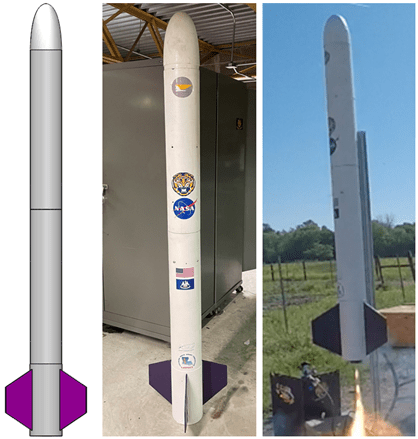
Project Scope: The Valkyrie rocket glider is the next iteration in a series of projects by Louisiana State University Senior Design Capstone Department in partnership with LaSPACE and Ascent Science Group. The goal of this project is to develop a small-scale, core-burning LN2O-Paraffin hybrid-powered rocket-glider by building upon the prior designs of Khaos, Icarus, Andromeda I iterations of the project series while remaining under the total project budget of $4000. Team 20 has designed a new dependable ignition system, mechanical interface wing rail system, and comprehensive flight electronics system for data capture and flight control. Valkyrie has also validated the design and analysis of the ground loading system, test/launch stand, rocket structure, and propulsion systems from previous projects with minor changes.
In this project the parts I oversaw where the developments to the electronics bay which consisted of the Parachute Deployment system and the navigation system.
The Parachute Deployment System:

From above we can see a an overview to the system. Where the parachute is deployed through the Arduino transmitting a signal to the relay which is is sent manually or automatically.
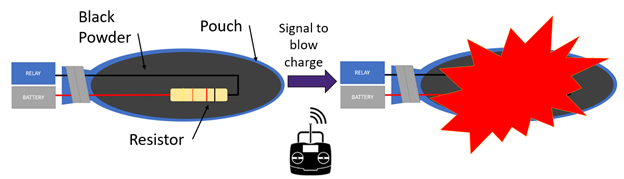
Twenty-two-gauge wire runs from the electronics bay to the leads with a 10 Ω resistor connected. The resistor and top portion of the leads are embedded in a pouch with the loose black powder. The top portion of the leads and pouch are twisted and wrapped tightly using electrical tape. The bottom portion of the leads are connected to a relay, SRD-05VDC-SL-C, which is compatible with the Arduino Uno. It is triggered by the Arduino Uno through the microcontroller setting a pin to high which causes the relay to close enabling 22V to be sent across the resistor see. The ejection charge size was based on the Ideal Gas Law and the parachute manufacturer’s recommended ejection pressure. The nose cone and parachute eject, allowing the parachute to expand and descend the flight vehicle. The parachute and nose cone are connected to the fuselage interior by a Kevlar shock cord and carabiners.
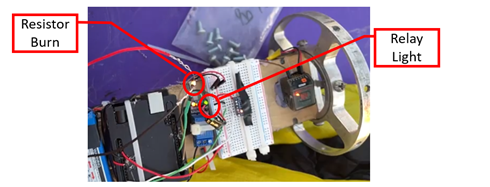
Automatic parachute ejection altitude was based on the deployment charge delay identified during the recovery system testing. The charge delay had an estimated been approximated to be 2.5 second. This was included when calculating the deployment of the charge forces. The trigger altitude through propulsion calculations performed by Madeline Kirby gave us the altitude height which was 653 ft. This value was input into the code for the Arduino’s automated parachute deployment system. This way, the charge would deploy the parachute at the instant apogee was reached. With an estimated delay of 2.5 seconds, the trigger altitude for the deployment charge was set to the flight model altitude of 653 ft. This value corresponds to the predicted height 2.5 seconds prior to reaching apogee.
 Claire K Pearson